A more in-depth analysis of one recipe
Monthly Archives: September 2024
Treating an unfortunate injury
I have always had weak ankles that tend to roll and I managed to roll both of mine a few weeks ago and fracture both fibulas. The orthopedic doctor says I’m going to heal just fine so this is a golden opportunity to explore period treatments! Guy de Chauliac (published 1363) gives this advice for fractured fibulae:
“The tibia may be fractured alone or with the fibula… When the fibula alone is fractured it can be displaced forward or inward… Both Albucasis and Halyabbas treated the fractures as they did fractures of the forearm bones, except that here they placed two splints between the bones, the full length of the leg, and they used a cradle.” p. 421
I went to the ER and they splinted both legs so step 1 accomplished.
“These medicines may be used as washes, plasters, or ointments. Avicenna explained their purposes; most important is the reduction of swelling and to relieve pain. Also, they may promote the union by toughening the callus, and they may comfort the limb… The medicines to reduce the swelling are refigerants and repercussives, such as egg white, rosat oil, and myrtle oil applied early in the course.
These toughen the callus and reduce its bulk, and support the fracture until the callus has fulfilled its purpose. The Simples are wheat-mill dust, wheaten flour, sangdragon, frankincense, mastic, sarcocolla, and egg whites.” p. 625
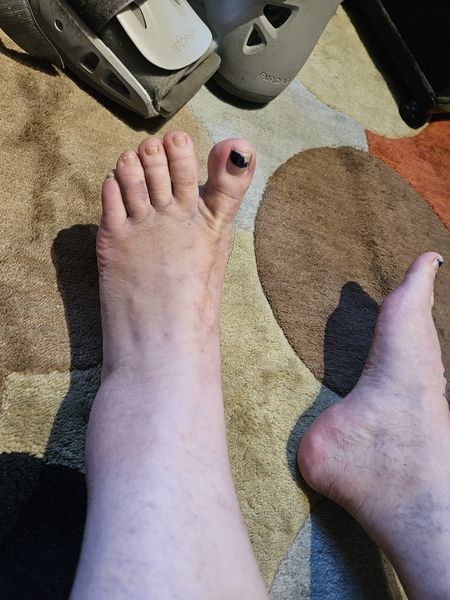
I have frankincense and mastic in the house, I chose to use mastic mixed in olive oil to massage the area. I will do so every day for a few days then report back.
Source: Guy, Rosenman, L. D., & Nicaise, E. (2007). The major surgery of Guy de Chauliac: Surgeon and master in medicine of the University of Montpelier: Written in 1363, here re-edited and collated from Latin and French editions and complemented with illustrations, supplemented with notes and an historical introduction about the Middle Ages and the life and the works of Guy de Chauliac. Xlibris Corporation.
Viking Tooth Filing
Aesthetic tooth filing is a practice that has only been used by a few cultures in history. In Europe it only showed up in the late Viking era, almost entirely in and around Gottland. While many skulls have been found with the tooth alteration, written evidence is almost non-existent (there may be brief mentions in the sagas but I have not yet come across anything I thought could plausibly refer to it). Here is my paper from Kingdom Arts and Sciences 2024:
When I got feedback on my presentation I realized that I had not effectively explained why I didn’t demonstrate on human upper front teeth. The reasons are:
- The exact shape of the tooth effects the filing pattern so I needed to demonstrate on something approximately the shape of a human upper incisor
- Real human incisors are nearly impossible to source ethically, unlike human molars
I have since acquired plastic teeth in a full mouth model to practice on and I’m going to reach out to some local butchers to see what animal teeth I can procure that may be somewhat similar in shape to human.
My next step is to branch out to Central American tooth decorations which involved gluing semiprecious stones to teeth, and Filipino decorations in gold.
Dentistry part 2: Herbalism
I struggled for many years trying to find a way to effectively share period herbal dental remedies because they are so copious and wildly divergent. I finally decided on a meta-analysis of recipes.
Dental Medicine Part 1: Surgery
From roughly 900 AD until the late 19th century AD dentistry was segmented (I can/will elaborate at some point…. or if you ask) between surgical/physical treatments and herbal/magical treatments. This paper was the culmination of my learning to date.
An Info-Dump
Link to my first set of Online Atheneum entries:
https://athenaeum.baronyofmadrone.net/exhibits/against-sunburn/
Suncream a la Trotula – an evolving experiment in period solutions to modern problems
A few years ago I stumbled across two recipes in the Trotula (https://www.pennpress.org/9780812235890/the-trotula/) that are for treating sunburn/windburn, but at the end they say they are also good for prevention of the same. As a Translucent American with sensitive skin, I was intrigued by the idea of a period-appropriate sunscreen. My research and understanding have grown a lot over the last few years.
Here is a link to my first presentation: https://athenaeum.baronyofmadrone.net/exhibits/against-sunburn/
my paper for the 2024 Kingdom competition: AN 11TH CENTURY ITALIAN SUNSCREEN
Since then I have looked further into similar creams and discovered that tin oxide was often used interchangeably with white lead and zinc oxide – I acquired some white lead to do a test batch (yay toxins!) but it’s proving to be difficult to get tin oxide in less-than-industrial amounts.
In my totally non-modern-scientific experiments I can report that the cream as I made it is VERY effective at preventing sunburn. It is functional for about 24 hours in high heat (lots of sweat). I tried using coconut oil to make a vegan version and sadly the coconut smell was overpowering. Crisco did the job fairly well. I did a few batches with tallow I rendered myself but I have a hard time filtering the oil enough to get rid of the cow smell so I use commercially available lard when I make it for gifting.
A Long-overdue Introduction
Hello all!
I have been meaning to make a blog for my Arts and Sciences projects for years but the ADHD Fairies have only just now blessed me with the required Inspiration so there will be a LOT of older catch-up entries at first to get the majority of my stuff in one place.
I am Mecia Raposa, from the Barony of Madrone in the kingdom of An Tir. Mundanely I have been working in dentistry since 2004, which is how I fell into the rabbit-hole of historical dentistry which branched out into more general herbalism, surgery, and a little alchemy. I am also passionate about 16th century fencing, and I dabble in clothing, cooking, and brewing. I love nerding out about my interests so please feel free to ask questions!
 mecia577's Blog